Daily Weather with Surf, Wind and Tropical Storm Forecasts

Daily Baja Weather Forecast
Tuesday 08 September 2026 6:25AM PDT
Current Weather Conditions
A massive heat dome parked over the desert Southwest, working together with sinking air from decaying Tropical Storm Marie spinning offshore, will keep the peninsular interior baking today while wiping out our usual coastal marine layer.
With nearshore ocean waters warming up noticeably along the Northern Baja Pacific, early morning low clouds and patches of mist are set to burn off quickly. That sets up a much warmer, sun-drenched afternoon right down to the sand.
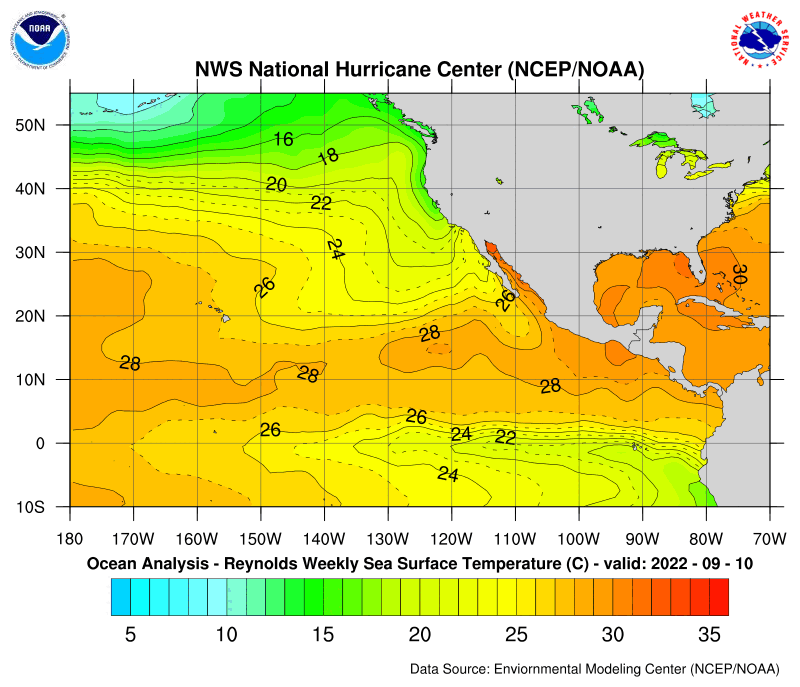
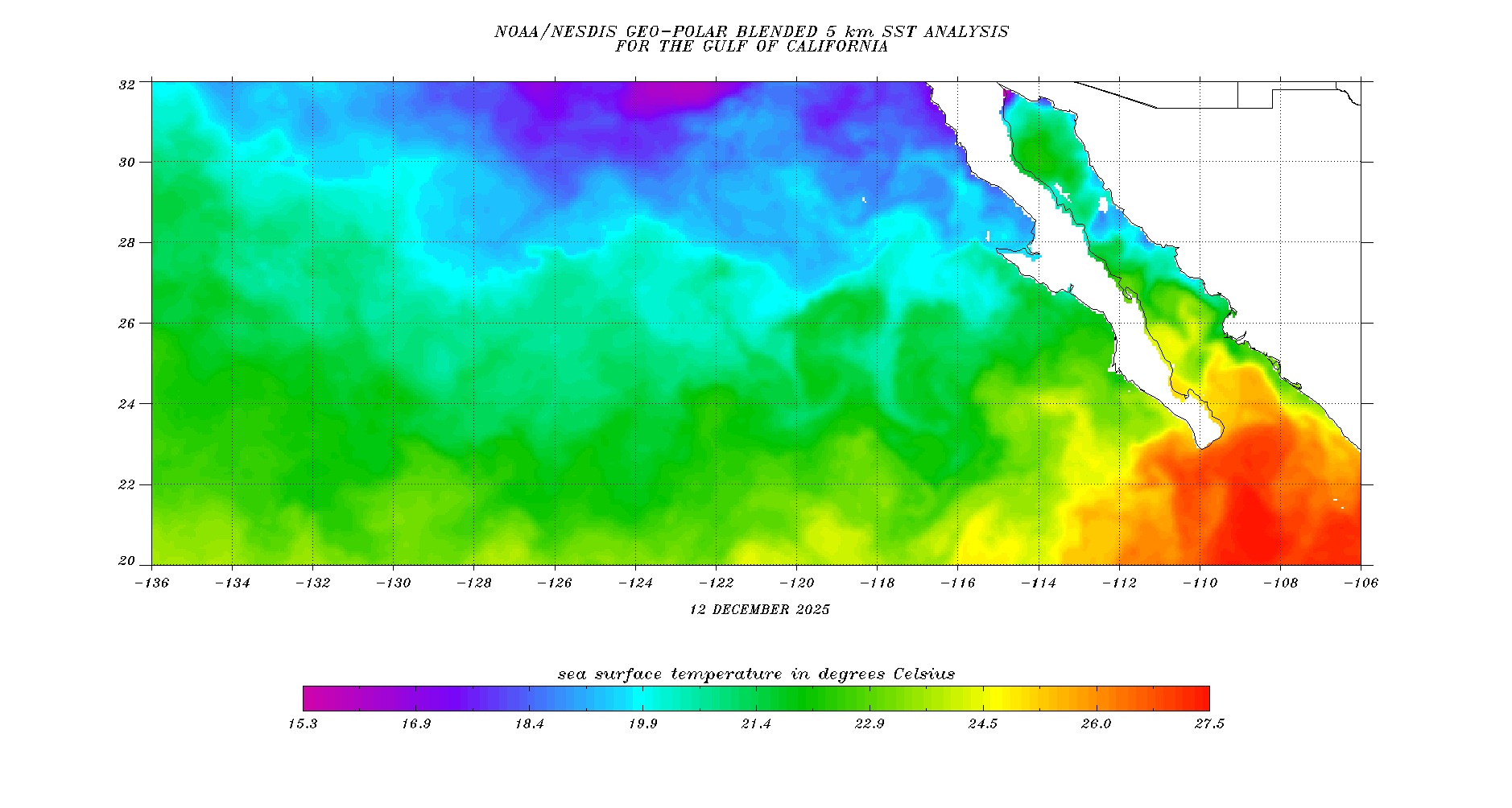
Over on the Gulf of California side, exceptionally warm sea surface temperatures are acting like a giant open-air sauna. This heated water is pumping heavy moisture into the air, driving the apparent heat to intensely sticky, sweltering levels and feeding afternoon cloud buildups over the central mountains.
Tropical Moisture & Marine Advisory
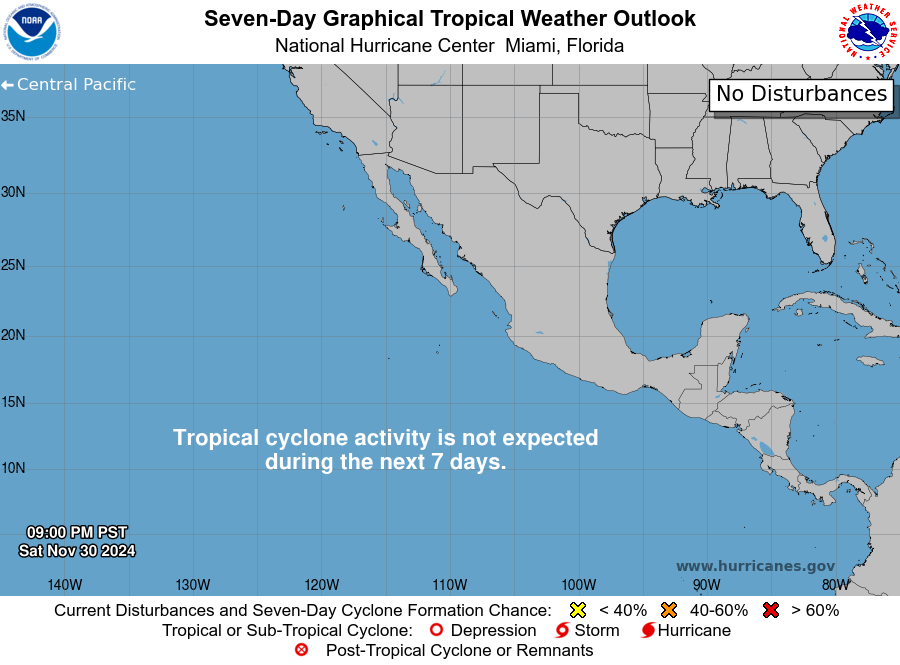
We are issuing an early heads-up for our southern and central communities regarding an organizing tropical disturbance located several hundred miles southwest of mainland Mexico. The National Hurricane Center now gives this system a high 70% chance of forming into a tropical depression as it tracks toward the Revillagigedo Islands later this week.
While direct land impacts are not expected at this time, this developing system will act like an atmospheric moisture pump starting Friday and lasting through the weekend. Expect a significant surge of tropical humidity, thicker cloud decks, and heightened afternoon thunderstorm chances across the mountains, along with elevated southerly swell running up our Pacific beaches.
Regional Forecast for Today
Baja California
Morning low clouds and shallow mist along the Northern Baja Pacific coast—including Playas de Tijuana, Rosarito Beach, Ensenada, and San Quintín—will clear out completely by mid-morning. This quick clearing will leave our beach communities feeling much warmer than normal under bright, sunny skies, with only a gentle afternoon sea breeze offering minor relief.
Just a few miles inland, the heat turns up fast. The valley floors and desert corridors around Tecate, Mexicali, and Cataviña will be blisteringly hot under relentless sunshine.
Up in the higher mountain elevations of Laguna Hanson and the Sierra de San Pedro Mártir, expect a pleasantly warm afternoon with partly cloudy skies and a few puffy clouds before cooling down comfortably after dark.
Down along the upper Gulf of California, San Felipe and Puertecitos will endure an intensely hot, muggy day with blazing sunshine. Bahía San Luis Gonzaga will start out mostly sunny before afternoon clouds drift overhead, with light to moderate southeasterly breezes creating a choppy surface on the water.
Baja California Sur
The southern half of the peninsula remains wrapped in a sticky, tropical air mass today. Mid Baja Pacific and Southern Baja Pacific communities from Guerrero Negro and the Vizcaíno plain down through Bahía Asunción, Punta Abreojos, San Juanico, and San Carlos will see partly cloudy skies, feeling a lot hotter throughout the day with moderate westerly breezes picking up by mid-afternoon.
Along the central Gulf of California shoreline, very warm nearshore waters will keep Santa Rosalía, Mulegé, and Loreto feeling remarkably muggy, sticky, and sweltering under partly to mostly cloudy skies, with isolated showers nearby.
Across the Cape region and southern agricultural valleys, deep tropical moisture will blanket Ciudad Constitución, La Paz, Los Barriles, Todos Santos, and Cabo San Lucas in thick, muggy air. Conditions will stay sweltering under partly to mostly cloudy skies, with afternoon thunderstorms and brief tropical downpours likely building over the interior peaks and foothill canyons.
National Hurricane Center (NHC) Tropical Update
Eastern Pacific Tropical Outlook
The National Hurricane Center is monitoring multiple systems across the eastern Pacific, but none pose a direct threat of making core landfall on our peninsula.
Tropical Storm Marie is running out of steam over colder waters several hundred miles west of Punta Eugenia. Forecasters expect Marie to weaken to a remnant low over the next day or so as it drifts away into the open ocean. However, Marie’s parting gift is a hefty set of long-period southerly swells. These waves will peak around this evening’s high astronomical tide, bringing rough surf, minor beach berm wash, and dangerous rip currents to exposed Pacific beaches.
Way out to the west, Hurricane Lowell is brushing past Hawaii and stays far away from us. To the south, that organizing disturbance southwest of Mexico will be the main feature to watch as it heads toward the Revillagigedo Islands later this week, with another weak disturbance possibly trailing behind it over the weekend.
Boaters, fishermen, and beachgoers along our Pacific coastlines should stay alert for rough breaker action and strong currents along all south- and southwest-facing shores over the next couple of days.
7-Day Extended Outlook
Our late-summer heatwave will hold the steering wheel through the middle and latter parts of the workweek. The Northern Baja Pacific coastline will continue to see quick morning clearing, leading to unseasonably warm afternoons at the beach and muggy nights. Meanwhile, the interior deserts and the entire Gulf of California coast will stay blisteringly hot, with high humidity shutting down any real nighttime cooling.
As we head into the weekend, two competing weather players will enter the arena. To the south, that developing tropical system will steer a plume of deep tropical moisture across the southern and central peninsula. This will keep humidity high, spark afternoon showers over the mountains, and send continuous pulses of southerly swell up our coastlines.
At the same time, an approaching weather trough moving into the Pacific Northwest will begin chipping away at the stubborn heat ridge baking the north. By Sunday and early next week, this shift will allow cleaner, fresher ocean breezes to push across the Northern Baja Pacific. That means noticeably cooler, more comfortable afternoons for our northern valleys, with nighttime lows finally tumbling back down to pleasant levels and washing out the tropical mugginess.
———————–


NE Pacific Marine Report
Developing Marine Patterns
A degrading pressure gradient between an expansive continental heat dome anchored over the southwestern United States and the unraveling circulation of Tropical Storm Marie offshore will govern the peninsular marine boundary layer today. Marie, centered near 25.5°N, 126.6°W with 45 mph sustained winds, will continue to weaken rapidly over sub-26°C waters and transition to a post-tropical remnant low within the next 24 hours before dissipating west of the peninsula by Thursday afternoon.
Meanwhile, deep equatorial moisture trailing northeastward from Marie will continue to blanket the peninsula with elevated precipitable water, suppressing the traditional marine layer and holding overnight coastal cooling to near zero. Nearshore seawater temperatures will remain unseasonably warm, ranging from 70°F to 73°F along the Northern Baja Pacific and sitting between 85°F and 91°F across the Mid Baja Pacific, Southern Baja Pacific, and the entire Gulf of California. Further south, the National Hurricane Center is tracking a consolidating broad area of low pressure several hundred miles southwest of southwestern Mexico that carries a high 70% probability of tropical cyclogenesis over the next seven days, as well as a secondary low-pressure area developing well south of the peninsular tip this weekend with a 20% formation chance.
Decaying long-period south swell from Marie will produce elevated surf and hazardous rip currents along the Pacific coastline today, while an incoming 16-to-17-second swell train will arrive Wednesday night into Thursday. Regional thermal low pressure over the interior will sustain moderate southerly breezes and short chop across the Gulf of California.
Regional Marine Reports
Northern Baja Pacific
Offshore waters from the international border south past San Quintín to Punta Eugenia will see lingering morning mid-level clouds clear out, yielding mostly sunny skies during peak insolation hours. We expect northwest to north winds to blow at 10 to 15 knots within 60 nautical miles of the coast, while waters out to 250 nautical miles will see northwesterly winds holding near 10 knots today before turning variable under 5 knots nearshore by Wednesday morning. Nearshore seas will run 4 to 6 feet along the border sector and 5 to 7 feet south toward Punta Eugenia in decaying south-southwest swell at 11 to 12 seconds today, building into a powerful 17-second period by Wednesday night. Abnormally warm nearshore water temperatures of 70°F to 73°F will keep coastal beaches warm, with ambient daytime air temperatures reaching the range of 85°F to 88°F at the water’s edge and surging into the range of 92°F to 95°F across immediate coastal communities.
Southern Baja Pacific
Marine zones along the central and southern Pacific coastlines, from Punta Eugenia down through Punta Abreojos, San Juanico, and Todos Santos, will experience partly to mostly cloudy skies as multi-layered tropical cloud bands stream northward. Coastal winds will blow from the northwest to north at 10 knots today, with nearshore waters falling to light and variable winds under 5 knots tonight and Wednesday morning. Seawater temperatures will remain anchored between 85°F and 87°F, feeding high atmospheric moisture. Nearshore seas will run 4 to 6 feet today on an 11-to-12-second period in west to southwest swell, before dominant wave periods jump to an energetic 17 seconds by Wednesday. Scattered showers and isolated thunderstorms will remain active across these offshore waters through Wednesday morning, with ambient air temperatures reaching the range of 88°F to 91°F.
Northern Gulf of California
The upper basin near San Felipe, Puertecitos, and Bahía San Luis Gonzaga will see mostly sunny skies and intense ambient heat today, with Gonzaga seeing afternoon cloud buildups. We anticipate southeast to south winds blowing at 10 to 15 knots today through Thursday, with seas running 3 feet or less on a short, choppy 4-second period. A tighter pressure gradient will build southeast to south winds to 15 to 20 knots on Friday and Saturday, pushing squared-off chop to 3 to 5 feet. Seawater temperatures will remain superheated between 89°F and 91°F across this shallow basin, holding overnight lows in the oppressive range of 84°F to 86°F and driving heat indices well into the triple digits.
Southern Gulf of California
The central and lower Gulf basin, including waters off Santa Rosalía, Mulegé, Loreto, and La Paz, will see partly cloudy skies with afternoon convective buildups and isolated thunderstorm activity. Winds across the central Gulf will blow from the southeast at 10 knots today with seas of 3 feet or less on an 8-second period, accompanied by scattered showers and isolated thunderstorms. Waters across the southern basin and Gulf entrance will experience light and variable morning winds becoming southerly at 10 knots this afternoon, with seas of 2 to 4 feet on a 13-second period. Wave periods will stretch to 16 to 17 seconds Wednesday into Wednesday night. Deep water temperatures of 88°F to 90°F will sustain oppressive surface dew points, with ambient highs reaching the range of 91°F to 94°F.
Los Cabos
At the southern tip, coastal waters off Cabo San Lucas and the East Cape will see partly to mostly cloudy skies, with scattered showers and isolated thunderstorms active through the day and tonight. We expect morning winds north of 22°N to blow from the north to northeast at 10 knots before becoming variable under 5 knots, while waters south of 22°N will see northeast to east winds at 10 knots today, increasing to 10 to 15 knots on Wednesday. Water temperatures at the Cape confluence will remain deeply tropical between 88°F and 89°F. Nearshore seas will run 4 to 6 feet today on a 12-to-13-second period in west-northwest swell, building to 5 to 7 feet on Wednesday with swell periods lengthening to 17 seconds. Ambient air temperatures will hold in the range of 89°F to 91°F under heavy humidity.
Regional Offshore Wind & Wave Summary
Offshore Region | Wind Direction & Speed | Significant Wave Height | Dominant Wave Period |
Unit | (kt) | (ft) | (seconds) |
US-Mex Border to 30N (Within 60 nm) | NW to N 10 to 15 | 4 to 6 | 12 |
30N to Punta Eugenia (Within 250 nm) | NW to N 10 | 5 to 7 | 11 |
Punta Eugenia to Cabo San Lazaro | NW to N 10 | 4 to 6 | 11 |
Cabo San Lazaro to Cabo San Lucas | NE to E 10 | 4 to 6 | 12 |
Northern Gulf of California | SE to S 10 to 15 | ≤ 3 | 4 |
Central Gulf of California | SE 10 | ≤ 3 | 8 |
Southern Gulf of California | S 10 | 2 to 4 | 13 |
Marine Warnings and Hazards
Offshore Wind and Sea Hazards
An organizing tropical disturbance centered several hundred miles southwest of southwestern Mexico will produce fresh to strong northeast-to-east winds of 15 to 20 knots and rough seas of 6 to 8 feet across the waters surrounding the Revillagigedo Islands today through Wednesday night. Across the Northern Gulf of California, fresh southeasterly wind pulses will generate steep, choppy open-water conditions late in the week, building seas to 3 to 5 feet by Friday. Mariners operating across the Central Gulf of California, the Southern Gulf of California, and the Southern Baja Pacific should remain alert for localized squalls, sudden wind gusts, and cloud-to-water lightning associated with scattered convective thunderstorms through Wednesday.
Swell and Surf Warnings
Decaying south-to-southwest swell from Tropical Storm Marie will continue to produce breaker sets of 3 to 6 feet, with occasional sets reaching up to 8 feet on exposed south- and southwest-facing beaches along the Northern Baja Pacific today. This swell energy will converge with high astronomical tides during the evening hours, generating minor tidal overflow, localized beach berm erosion, and life-threatening rip currents from Playas de Tijuana south through Rosarito, Ensenada, and San Quintín through late tonight. While swell heights will step down slightly early Wednesday, a powerful reinforcing long-period swell pulse will stretch dominant wave periods to 17 seconds across the Pacific coast and the entrance to the Gulf of California Wednesday night into Thursday, sustaining hazardous shorebreak.
Extended Outlook
We anticipate Tropical Storm Marie will weaken to a tropical depression later today and degenerate into a post-tropical remnant low over cooler waters by Wednesday morning, completely dissipating by Thursday afternoon.
The extreme continental heat ridge suppressing the Northern Baja Pacific marine boundary layer will begin weakening by Thursday and Friday, allowing a shallow sea breeze to slowly re-establish along immediate beaches before a passing Pacific Northwest trough brings cooler, drier air and lower nighttime temperatures for Sunday and Monday.
Simultaneously, we will closely monitor the broad tropical low southwest of Mexico as it tracks west-northwestward at 10 to 15 mph. Forecasters project this system to form into a tropical depression later this week as it approaches the Revillagigedo Islands corridor, which will sustain elevated southerly swell energy and pump deep tropical moisture across the southern and central peninsula through the upcoming weekend.
———————–
Seawater Surface Temperatures (SSTs)
| Location | Temp | Trend | Notes |
| Bahía Asunción, BCS | 84.6°F | Cooling | Mid Baja Pacific southerly swell column mixing |
| Ba. Los Angeles, BC | 86.2°F | Steady | Northern Gulf of California tidal channel current stabilization |
| Ba. San Ignacio, BCS | 86.9°F | Cooling | Mid Baja Pacific shallow lagoon outflow cooling |
| Bahia Gonzaga, BC | 88.9°F | Warming | Northern Gulf of California shallow embayment thermal gain |
| Cabo San Lucas, BCS | 88.3°F | Steady | Southern Baja Pacific deep tropical water mass retention |
| Cabo San Quintín, BC | 72.3°F | Warming | Northern Baja Pacific upwelling suppression under southerly swell |
| Ensenada, BC | 72.7°F | Warming | Northern Baja Pacific boundary layer solar insolation gain |
| Erendira, BC | 70.5°F | Warming | Northern Baja Pacific upwelling breakdown and coastal surge |
| Guerrero Negro, BCS | 83.3°F | Warming | Mid Baja Pacific solar heating over shallow lagoon flats |
| La Paz, BCS | 87.8°F | Cooling | Southern Gulf of California convective cloud cover moderation |
| Loreto, BCS | 89.6°F | Warming | Central Gulf of California high surface heat retention |
| Los Barriles, BCS | 89.1°F | Steady | Southern Gulf of California thermal baseline holding firm |
| Mulege, BCS | 89.3°F | Cooling | Central Gulf of California convective rain and cloud shade |
| Playas de Tijuana, BC | 73.2°F | Warming | Northern Baja Pacific nearshore warming and weak onshore flow |
| Puertecitos, BC | 90.5°F | Warming | Northern Gulf of California extreme shallow basin heat accumulation |
| Punta Abreojos, BCS | 85.5°F | Cooling | Mid Baja Pacific long-period swell mixing coastal waters |
| Rosarito Beach, BC | 69.6°F | Warming | Northern Baja Pacific marine layer absence boosting surface temps |
| San Carlos, BCS | 86.7°F | Cooling | Southern Baja Pacific tidal exchange and swell disturbance |
| San Felipe, BC | 90.7°F | Warming | Northern Gulf of California extreme thermal saturation |
| San Juanico, BCS | 87.3°F | Cooling | Southern Baja Pacific southerly swell vertical column mixing |
| Santa Rosalia, BCS | 85.6°F | Cooling | Central Gulf of California localized convective storm runoff |
| Santa Rosaliíta, BC | 77.0°F | Warming | Central Baja Pacific light wind regime allowing surface warming |
| Todos Santos, BCS | 87.1°F | Cooling | Southern Baja Pacific long-period swell water column turnover |


Tropical Storm Weather Forecast

CURRENT ACTIVE SYSTEMS



Offshore Waters Forecast (E Pacific Offshore of Mexico)
Windy 10 Day Forecast
GFS Model
ECMWF Model (European)
Atmospheric Pressure Changes
Sea Surface Temperatures (SST's)